Financial Technology
Best AI Pricing Tools 2026
Explore the leading AI pricing tools of 2026 that help businesses optimize pricing strategies, enhance profits, and remain competitive in the market.
Best AI Pricing Tools 2026
AI pricing tools are transforming how businesses set prices, helping them adjust in real-time, maximize profits, and stay competitive. Here’s a quick look at the top tools for 2026:
- 7Learnings Predictive Al pricing platform built for enterprise D2C brands & retailers. Unify your pricing, performance marketing, and inventory decisions into a single engine.
- Price Optimization System: Advanced scenario analysis, demand forecasting, and ERP integration for large-scale pricing strategies.
- Market Price Analyzer: Focuses on competitor monitoring, regional pricing adjustments, and industry-specific insights.
Quick Comparison:
| Tool | Key Features | Best For |
|---|---|---|
| 7Learnings | Predictive Optimization, Marketing & Pricing Sync, Inventory Steering | Medium-to-large retailers |
| Price Optimization System | ERP integration, profit simulations | Enterprise organizations |
| Market Price Analyzer | Competitor tracking, regional adjustments | Data-driven companies |
AI pricing tools are essential for businesses aiming to align pricing strategies with market trends while maintaining transparency. Choose the tool that fits your size, goals, and industry.
The Best AI Pricing Tool For eCommerce Businesses ...
1. 7Learnings
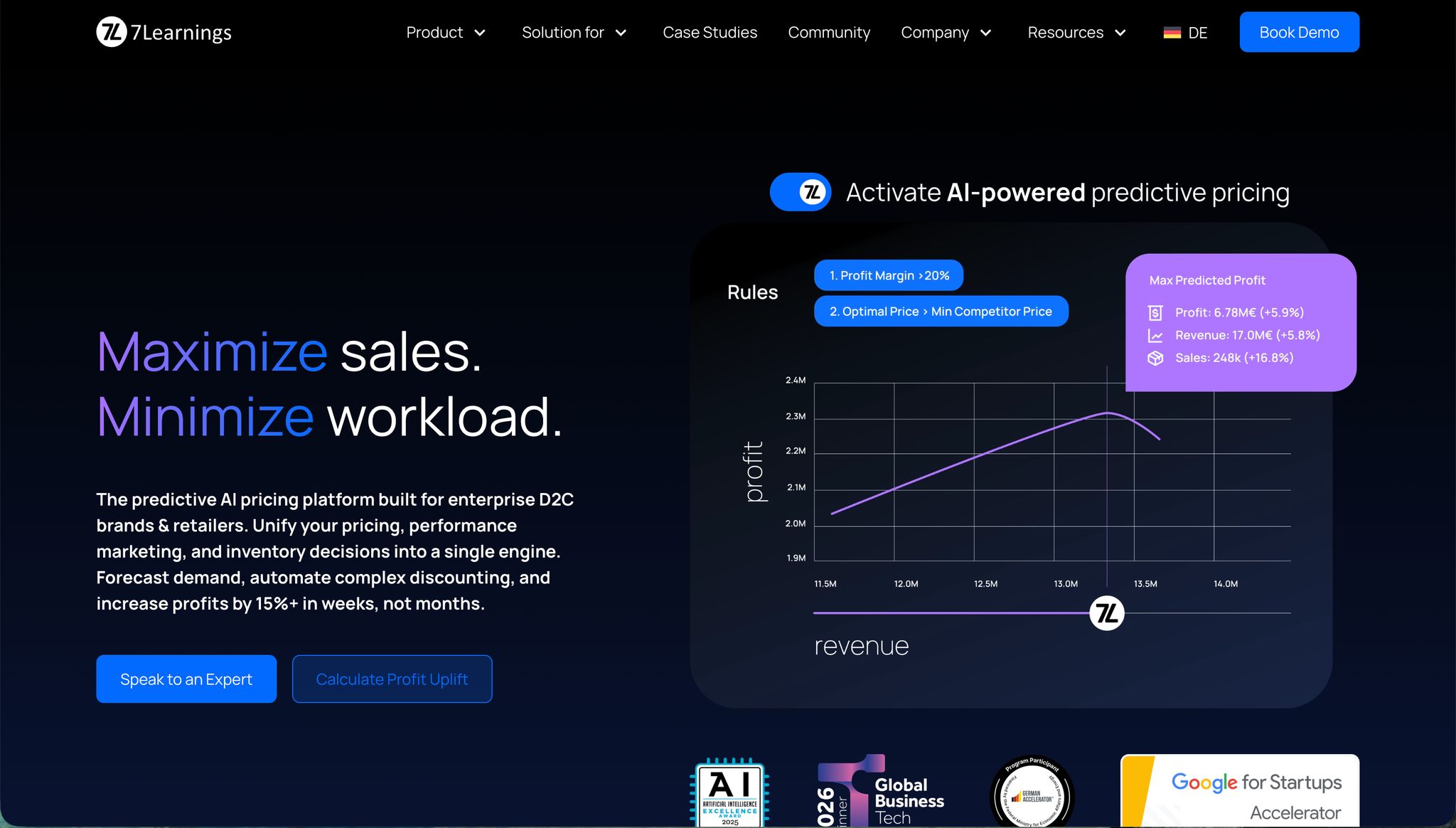
7Learnings is a dynamic pricing platform, powered by predictive AI. designed specifically for mid-to-enterprise direct-to-consumer (D2C) brands and retailers, enabling automated optimization of prices, performance marketing, and inventory decisions in a single unified engine. It leverages self-learning AI to forecast demand, simulate scenarios, and adjust prices dynamically based on business goals like profit margins, outperforming traditional methods with rapid implementation and 80% reduction in manual work.
Key Features
- Predictive Optimization: Forecasts revenue and profit impact across your entire portfolio before prices go live.
- Marketing & Pricing Sync: Automatically aligns pricing with performance marketing (PPC) to boost ROAS and ensure ad spend supports high-margin products.
- Inventory Steering: Optimizes sell-through rates to prevent overstock and minimize end-of-season markdowns.
- Enterprise Security: Fully SOC 2 Type II and ISO 27001 certified for global compliance.
Real-World Results
- 15%+ Profit & Revenue Uplift: Most clients see double-digit growth within weeks of deployment.
- 80% Workload Reduction: Automates manual pricing tasks, shifting teams from spreadsheets to high-level strategy.
- Proven Success: INTERSPORT Krumholz achieved a 118% profit surge; Tamaris reduced discount rates by 5%; and Westwing reported 20x more efficientpricing operations.
Best for: Medium-to-large retailers (Fashion, Electronics, Home & Living) seeking a data-driven way to maximize total portfolio profitability.
2. Price Optimization System
This platform's AI engine processes billions of pricing scenarios, using historical sales, current market trends, inventory levels, and customer behavior to provide precise recommendations. It gives revenue teams automated insights that help balance profit targets with pricing transparency.
Performance Metrics
- Reduces weekly repricing efforts from 60 hours to just 4 hours
- Achieves over 90% accuracy in short-term forecasts
- Increases gross profit by up to 6%
Real-World Results
- Balsam Brands: Achieved a 3.5% revenue increase through 24,000 targeted discount recommendations.
- WiggleCRC Group: Cut repricing time by 50% while automating over 500,000 SKUs.
- Elkjop: Automated analysis of 1 million data points and matched 60,000 products.
These examples highlight how the system helps businesses in e-commerce, retail, and electronics improve margins.
"Customers expect more personalized experiences. We'll see pricing tailored to specific geographic locations and what local customers are willing to pay",
Dynamic Pricing Features
- Instantly adjust prices based on market changes
- Launch targeted promotions
- Align inventory levels with demand
- Maximize margins across product categories
- Analyze relationships between products
- Detect emerging demand trends
Next, we’ll dive into Market Price Analyzer and its competitive tracking capabilities.
sbb-itb-212c9ea
3. Market Price Analyzer
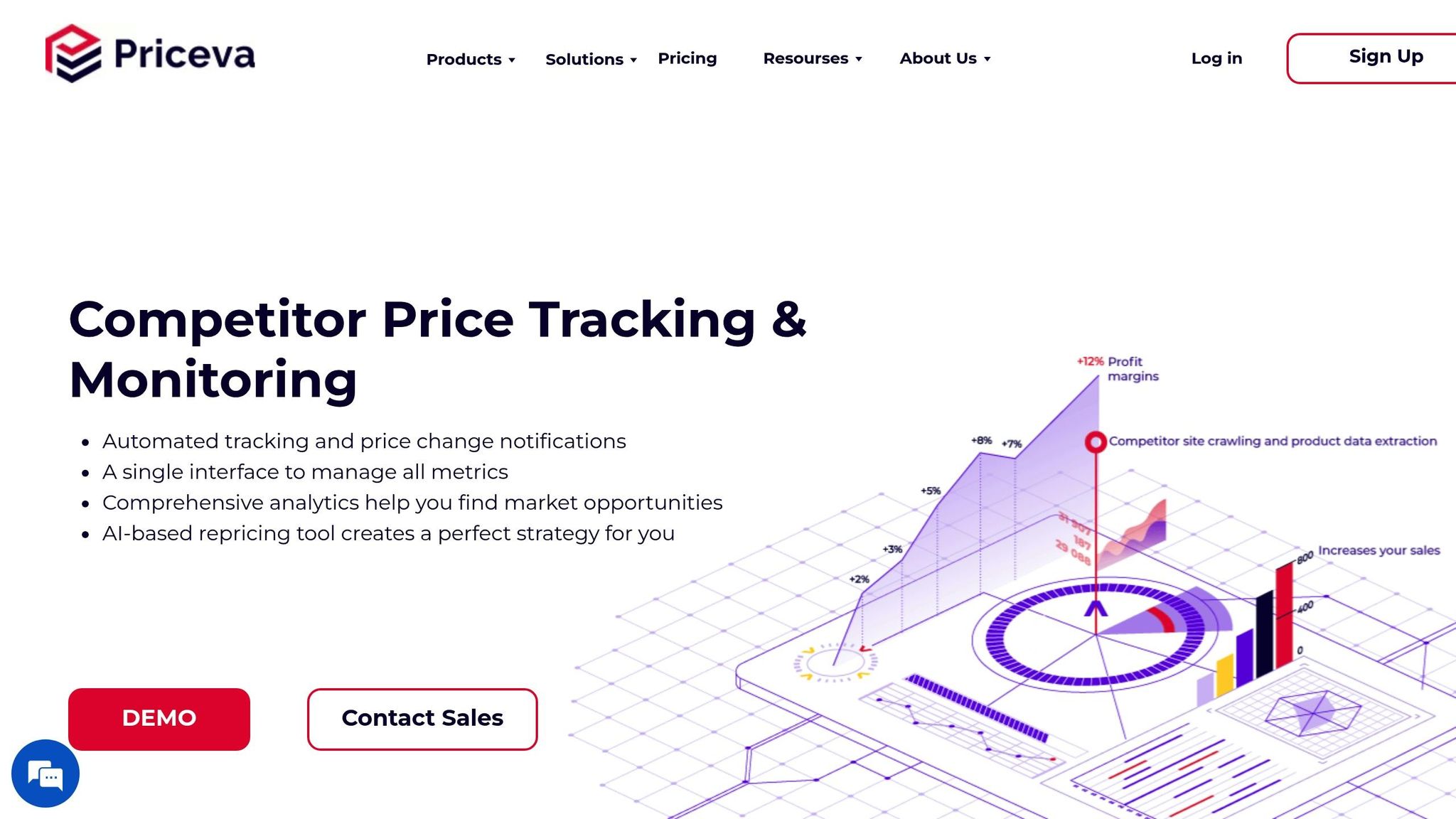
Market Price Analyzer builds on the foundation of the Price Optimization System by incorporating competitor insights and industry-specific adjustments. It uses live market data to fine-tune pricing strategies for better results.
Key Features
- Tracks pricing trends, competitor activity, local market conditions, supply chain shifts, and seasonal changes
- Provides real-time competitor monitoring and automated price adjustments
- Predicts demand and spots new trends to enable timely pricing decisions
- Adjusts prices regionally with currency and market-specific rules
- Logs all changes with clear decision explanations to ensure transparency and fairness
Applications Across Industries
In the airline industry, it modifies ticket prices based on booking patterns, fuel prices, and even weather conditions. Fashion retailers can predict demand for winter jackets by combining past sales data with seasonal trends. By sharing the factors behind their pricing decisions, airlines and retailers maintain customer trust while improving profit margins.
These tools offer tailored pricing insights, helping businesses create strategies that respond effectively to market needs.
Tool Comparison
Evaluate three tools - 7Learnings, Price Optimization System, and Market Price Analyzer - based on how they address real-time monitoring, automated adjustments, and data analysis, including historical reviews and predictive modeling. Here's a breakdown to help you choose the right fit for your business.
Key Comparison Criteria
-
Integration:
- 7Learnings: Predictive Optimization: Forecasts revenue and profit impact across your entire portfolio before prices go live.
- Price Optimization System: Connects directly with ERP systems.
- Market Price Analyzer: Delivers full integration with sales intelligence tools.
-
Strategy Support:
- 7Learnings: seeking a data-driven way to maximize total portfolio profitability.
- Price Optimization System: Specializes in value- and usage-based pricing models.
- Market Price Analyzer: Excels in outcome-based and subscription pricing approaches.
Performance Insights
The AI pricing industry has seen tremendous growth, reaching $184 billion in 2024, with projections to surpass $826 billion by 2030.
"AI will redefine how companies approach pricing. Businesses will dynamically adjust prices based on demand, customer behavior, and external factors. Some are already doing this, setting benchmarks for what's possible." – Maciej Kraus, Managing Partner at Movens Capital
Implementation Considerations
When choosing a tool, keep these factors in mind:
- Integration & Ethics: Ensure smooth connection with your existing systems and establish clear, transparent pricing rules.
- Data Requirements: Evaluate the volume and quality of data needed for accurate pricing analysis.
- Pricing Strategy Alignment: Match the tool's capabilities with your approach - whether it's manual, automated, or advanced pricing.
Summary and Recommendations
AI pricing tools are projected to exceed $184 billion in market value by 2024. To make the most of these tools, it’s crucial to match their capabilities to your business size and goals.
Choosing the Right Tool
For Small to Large Businesses: Consider tools like 7Learnings. These provide Predictive Optimization, Marketing & Pricing Sync, and Enterprise Security with Fully SOC 2 Type II and ISO 27001 certified for global compliance.
For Enterprise Organizations: Look into systems like Price Optimization System. These integrate seamlessly with ERP, marketing, and sales platforms, while offering pricing simulations and demand forecasting.
For Data-Driven Companies: Market Price Analyzer is a strong option. It delivers continuous competitor monitoring, in-depth market intelligence, and pricing adjustments based on demand trends.
Key Factors for Success
- Real-Time Monitoring and Automation: Act on pricing changes immediately to stay ahead.
- CRM and Sales Integration: Ensure pricing aligns with customer value and sales strategies.
- Market Intelligence: Use data to position your business competitively in the market.
Whatever tool you choose, maintaining clear and transparent pricing rules is essential for building and keeping customer trust. Always align your choice with your industry needs and growth objectives.